
The Biggest Animals Kingdom and in The World | Cheetah | The genus name, Acinonyx, means "no-move-claw" in Greek, while the species name, jubatus, means "moon" in Latin, a reference to the moons in cheetah cubs. The cheetah has unusually low genetic variability. Skin grafts between unrelated cheetahs illustrate the first place, that there is no rejection of the donor skin The cheetah has probably developed in Africa during the Miocene (26000000 died 7.5 million years old), before migrating to Asia. The extinct genus Miracinonyx was extremely cheetah-like, but recent DNA research has shown that Miracinonyx inexpectatus, Miracinonyx studeri and Miracinonyx trumani (early to late Pleistocene), North America and in the "North American cheetah" are not found the true cheetahs, instead of close relatives of the Cougar. The cheetah chest is deep and its waist is narrow. The coarse, short fur of the cheetah is tan with round black spots measuring 2 to 3 cm (0.79 to 1.2 in), for which they some camouflage while hunting.

The cheetah has a small head with high-lying eyes. The adult cheetah weighs 21 to 72 kg (46 to 160 pounds). Cheetahs are 66-94 inches (26 to 37 in) tall at the shoulder. The males are usually slightly larger than females and have slightly bigger heads, but there is no great variation in cheetah sizes and it is difficult to distinguish between men and women on looks alone. Compared to a similarly sized leopard, the cheetah is generally shorter body, but is longer and longer tail (about 90 cm on average it (35 cm) tall) and so it seems more streamlined.

Some cheetahs have a rare fur pattern mutation of larger, blotchy, merged spots. Known as "King Cheetah" which they were once considered a subspecies forms, but are in fact the African cheetah, its unusual coat pattern is the result of a single recessive gene. The "king cheetah" is seen only in the wild a few times, but it has been bred in captivity. The cheetah paws have semi-retractable claws (known only in three other cat species, the fishing cat, the cat and the Iriomote cat Flathead) and provides extra grip in high speed chases. Dewclaw itself is much shorter and straighter than other cats. Unlike true big cats in the subfamily Pantherinae, the cheetah can purr as inhaled, can not yell. The cheetah is still considered by some to be the smallest of the big cats.

The thinner body frame of the cheetah is also very different from that of the leopard. he cheetah is an endangered species. Once widely hunted for its fur, the cheetah now suffers more from the loss of habitat and prey both. There are more geographically isolated populations of cheetahs, all of which are found in Africa or Southwest Asia. It is possible, but doubtful, that some cheetahs remain in India. The cheetah lives in areas with large land where prey is abundant. The cheetah in an open biotope, such as semi-desert, prairie, and thick brush life, but it's in a variety of habitats available. A study of female cheetahs in the Serengeti were sexually promiscuous and often have several boys of many men.

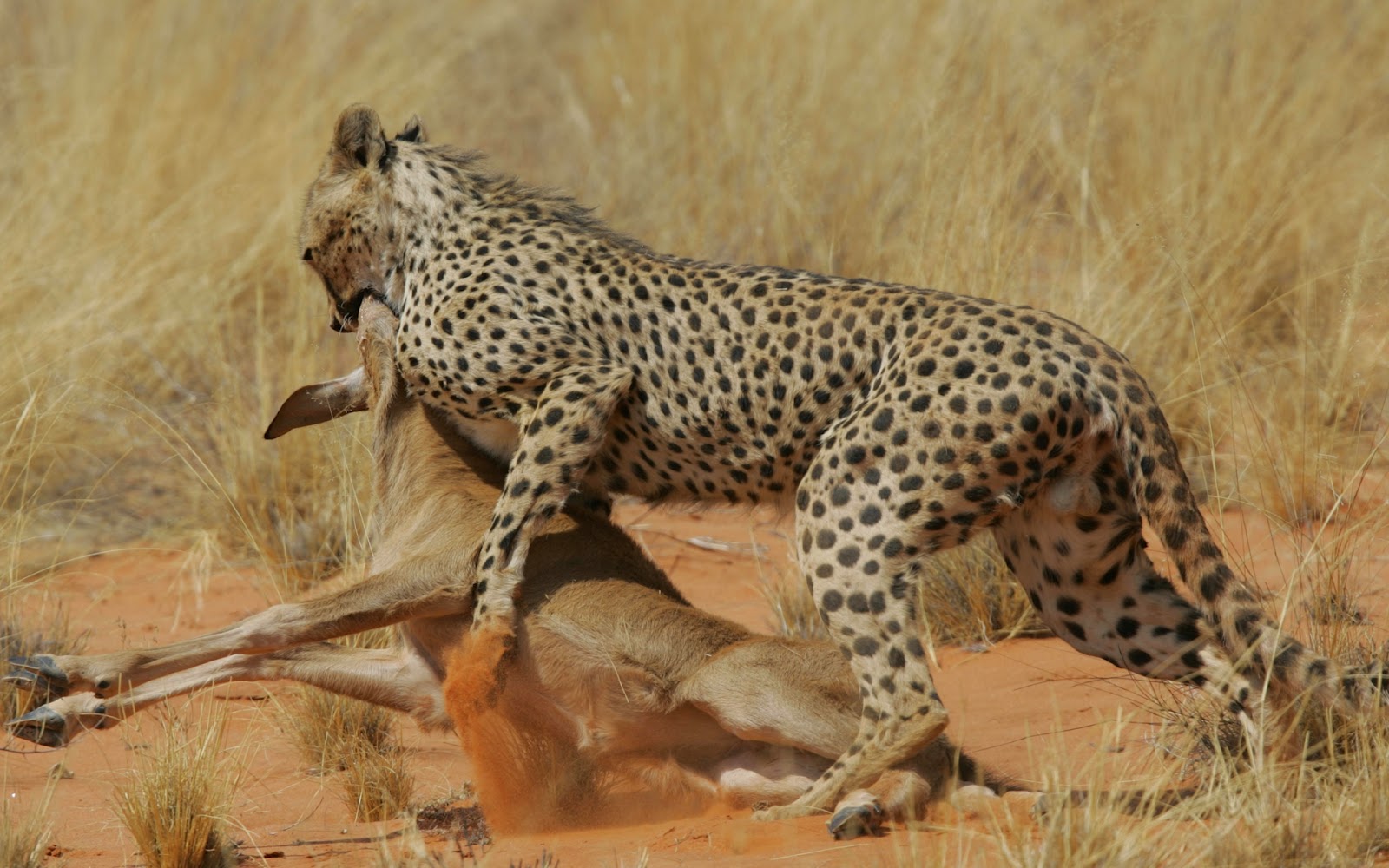
Unlike some other cats, the cheetah is born with its characteristic spots. This gives them a mane or Mohawk-type appearance, this fur is shed as the cheetah grows older. There is speculation that this mane gives a cheetah cub the appearance of the honey badger (rattle), deter potential aggressors. The cheetah has a unique, well-structured social order. Since cheetahs rely on their speed to get their meals, an injury that is slow it could be life threatening. A cheetah has a 50% chance of losing his prey to other predators. Cheetahs avoid competition by hunting at different times of day and by eating immediately after death.
As a result of the reduction of habitat in Africa, cheetahs have in recent years faced increasing pressure from other native African predators as available range decreases The cheetah is a very high mortality during the first weeks of his life, up to 90% of young cheetahs are during this time by lions, leopards, hyenas, wild dogs, or even killed by eagles. Young cheetahs often hide in thick brush for safety. Mother cheetahs defend their young and are sometimes successful in driving predators away from their young. Coalitions of male cheetahs can also chase away other predators, depending on the coalition and the size and number of predators. Because of its speed, a healthy adult cheetah has few enemies.
As a result of the reduction of habitat in Africa, cheetahs have in recent years faced increasing pressure from other native African predators as available range decreases The cheetah is a very high mortality during the first weeks of his life, up to 90% of young cheetahs are during this time by lions, leopards, hyenas, wild dogs, or even killed by eagles. Young cheetahs often hide in thick brush for safety. Mother cheetahs defend their young and are sometimes successful in driving predators away from their young. Coalitions of male cheetahs can also chase away other predators, depending on the coalition and the size and number of predators. Because of its speed, a healthy adult cheetah has few enemies.
Cheetah fur was formerly regarded as a status symbol. Today, cheetahs have a growing economic importance for ecotourism and they are also found in zoos. Cheetahs are far less aggressive than other big cats, and can be tamed, so cubs are sometimes sold illegally as pets. Cheetahs were formerly, and sometimes still hunted because many farmers believe that they eat livestock. If the species has been threatened numerous campaigns were launched to try to educate the farmers and to promote the cheetah. Recent research has shown that cheetahs will not attack and eat animals if they can avoid doing, if they prefer their wild prey.
Cheetah cubs have a high mortality due to predation by factors other predators such as lions and hyenas, and possibly genetic. It has been suggested that the low genetic diversity of cheetahs a cause of poor sperm quality, birth defects, cramped teeth, curled tail and limb is bent. Cheetahs are on the International Union for Conservation of Nature (IUCN) list of endangered species (subspecies in Africa threatened, Asiatic subspecies in critical condition) and the U.S. Endangered Species Act include: threatened species - Appendix I of CITES (Convention on International Trade in endangered species). Approximately 12 400 cheetahs remain in the wild in 25 African countries, Namibia has the most, with about 2,500. Another 50 to 60 of endangered Asiatic cheetahs are believed to remain in Iran.

Founded in 1990 in Namibia, the Cheetah Conservation Fund's mission in the world source responsible for the protection of cheetahs and secure the future of our planet. The South African Cheetah Conservation Foundation has close relations and facilitate the training and the exchange of program successes in other countries where cheetahs live, including Botswana, South Africa, Zimbabwe, Iran and Algeria.
Find The Biggest Animals Kingdom and in The World
Find The Biggest Animals Kingdom and in The World


